
This blog post brings together my professional role and IPA in EdD research to examine what children’s experiences of off‑site directions can teach us when we take time to listen. An off‑site direction is a formal arrangement in which a child is educated away from their main school, often following a period of instability or exclusionary practices. Many of the children I supported had moved schools repeatedly, their stories becoming fragmented along the way. Through this post, I reflect on why centring children’s voices is essential, how interpretative phenomenological analysis supported this work, and what others working in education or doctoral research may take from these insights.
Who I am: Secondary Outreach Lead, EdD researcher and why it matters
I am a Secondary Outreach Lead supporting children at risk of permanent exclusion. My background is in mainstream teaching, but when I moved into a senior leadership role within an Alternative Provision (AP), I quickly realised that I had found my place in education. Working with a committed team to support children who had been permanently excluded, or placed on dual registration, gave me a deep sense of purpose. I am also a member of SEBDA (Social, Emotional and Behavioural Difficulties Association) and BERA (British Educational Research Association), which continue to inform and strengthen my practice and research.
My work with these vulnerable learners inspired my Doctorate in Education (EdD); my research explored the lived experiences of children and key stakeholders involved in the managed move process. My professional role and doctoral study became closely connected, particularly through my use of IPA in EdD research to explore lived experience. My interest in this area stemmed from regularly working with children who had been moved from school to school to avoid permanent exclusion. I wanted to understand their experiences more deeply and give their voices the recognition they deserve.
Why I chose an EdD during the pandemic and what the journey revealed
The journey toward the EdD, began during the pandemic. After completing my Masters in Learning and Teaching with an emphasis on adolescent mental health, I honestly believed my studying days were over. I had a challenging but rewarding role, and no real intention of taking on doctoral study. However, the lockdown period gave me time to reflect on the children I supported and the patterns I observed across their educational journeys. I realised I wanted to advocate for them and their families, and to give voice to their stories and experiences.
Just before lockdown, my professional role changed, broadening my access to a wider range of students, families, and schools. This gave me the confidence to pursue the research I had been considering. I hadn’t thought too deeply about the financial or academic commitments of an EdD. I simply applied for a part-time place, thinking I would deal with those challenges if accepted. To my surprise, despite my application being misplaced initially, I was invited for a remote interview and successfully gained a place.
Balancing an EdD with full-time work and parenting: what actually worked
During the first three years, the taught modules ran as residential weekends, combining lectures, tutorials, and assignments. The modular structure of the EdD suited my circumstances well, balancing full-time work and parenting a daughter in secondary school. Adjusting to the demands of work, motherhood, and study was challenging. I often used school holidays to do the bulk of my writing and reading.
Peer support and workplace allies kept the momentum going
I became part of a supportive group of peers, and we navigated the course together until we reached the thesis stage. I had to learn to say “no” to social events and sometimes felt guilty about not being as present for family and friends. Starting a new role during the pandemic added another layer of complexity; after a full working day, I would go home, cook, support my daughter, and then begin studying. It was exhausting. Thankfully, I had a supportive team at work who acted as critical friends and sounding boards.
Over time, I began to see strong connections between my reading, research, and professional practice. My growing understanding of statutory guidance, evidence-based practice, and current research gave me confidence. There was a clear synergy between my day-to-day work and my doctoral studies, which enriched both experiences.
IPA vs thematic analysis in practice
I chose to use Interpretative Phenomenological Analysis (IPA) as my research approach because it enabled IPA in EdD research to foreground participants in the meaning-making. I also recognised that, for some, this might be the only opportunity they had ever had to do so. Beyond reading key texts and journals on IPA, I found it invaluable to speak with other researchers who had used the method.
IPA is often misunderstood or simplified as similar to thematic analysis. But, it is philosophically grounded in phenomenology, hermeneutics, and idiography, and requires deep engagement with data. What drew me to it was the privilege of exploring how people make sense of their lived experiences. It allowed me to compare participant experiences with existing guidance on off-site directions and to use my positionality as a practitioner-researcher to interpret these findings meaningfully.
Time planning for transcription, analysis and interpretation
As a novice researcher, I did not initially appreciate just how much time each phase would take. Transcription, analysis, and interpretation require patience and close attention. It was an intense but incredibly rewarding learning process. This was a point where an IPA-aware coach helped to scope tasks, set pace, and keep me focused on meaning making within my data.
Practical advice for EdD candidates: timelines, PETs/GETs, and reflective journals
Draw up a clear timeline and work backwards from your submission dates to plan realistically. Build in time to discuss your reflections, particularly when exploring Personal Experiential Themes (PETs) and Group Experiential Themes (GETs).
Engage with the literature
It is also important to keep revisiting the literature throughout your doctoral journey. The field evolves constantly and engaging with both current and foundational studies strengthens the depth and currency of your research.
Making reflection useful
Maintaining a reflective journal was invaluable. It helped me make sense of my interpretations, trace how my thinking developed, and understand the influence of my positionality as a researcher. Reflection became an essential part of meaning making.
How coaching accelerated my EdD: accountability, clarity, and confidence
Finally, having a coach who understood both IPA and the specific demands of IPA in EdD research made an enormous difference to my progress and wellbeing. Laura played multiple roles: a critical friend, a source of motivation, and a steadying presence during moments of doubt. At times, particularly when imposter syndrome crept in, their reassurance and encouragement helped me to refocus and believe in my capability. She also offered challenge in a constructive, supportive way, pushing my thinking further while keeping me grounded in the philosophy of IPA.
As I approached the final stages of writing up, Laura’s coaching support became even more important. She helped me to maintain focus, set realistic goals and timelines to meet my thesis deadline, and manage the emotional ups and downs that naturally come with the final phase of doctoral study. Having regular check-ins gave me a sense of accountability and perspective, especially when self-doubt crept in. The coaching relationship provided space to reflect, to stay motivated, and to reframe challenges when they felt overwhelming. Having someone who truly understood the pressures of the process, and who balanced gentle challenge with empathy and encouragement, was invaluable for my overall wellbeing and sense of progress.
Presentations:
BERA International Conference – September 2026 (abstract accepted March 2026) Reframing Exclusion: Language, Managed Moves and Off-site Directions
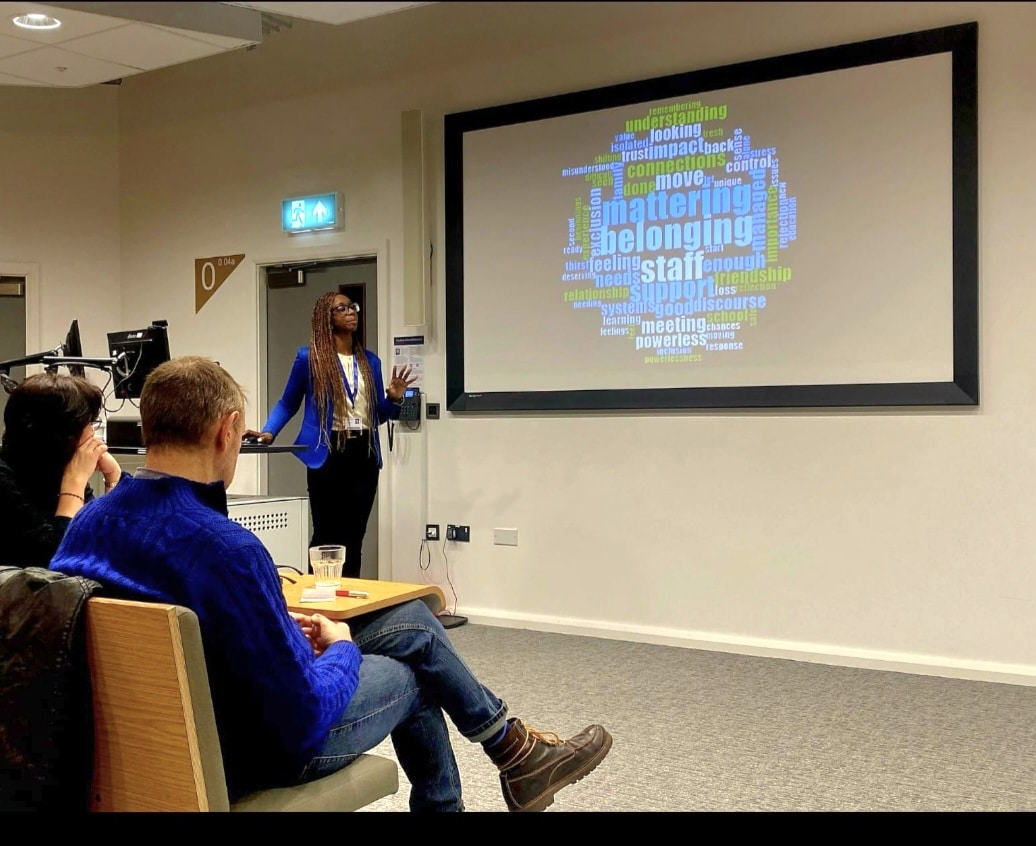
SEBDA International Conference – September 2023
The discourse of exclusion: what does the language used in a permanent exclusion tell us about the reality of inclusion in the education system?
https://sebda.org/conference-report/
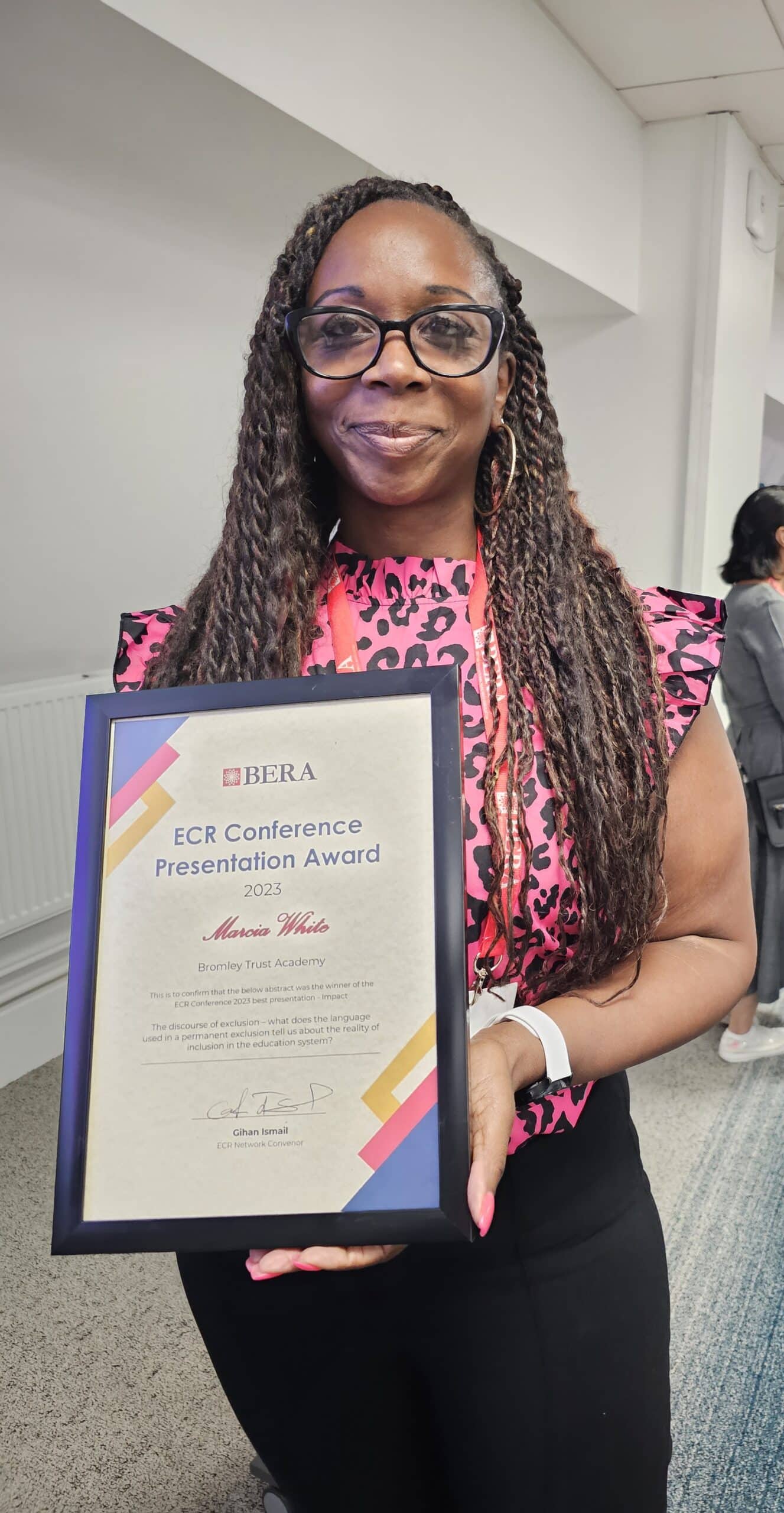
BERA ECR Best Presentation Award – September 2023
https://www.bera.ac.uk/award/bera-ecr-conference-best-presentation-award
BERA ECR Presentation – May 2023
The discourse of exclusion: what does the language used in a permanent exclusion tell us about the reality of inclusion in the education system?
https://www.bera.ac.uk/wp-content/uploads/2022/11/Marcia-White.pdf
Publications
EBD Journal Article on Managed Moves – June 2025
https://www.tandfonline.com/doi/full/10.1080/13632752.2025.2512706
Professional links
LinkedIn: https://www.linkedin.com/in/marcia-white-349b05139
Awesome !!